Does stingray foraging impact eelgrass seed dynamics in North Carolina’s meadows?

Stingrays dig into sediment in search of clams, crabs, and more tasty treats. Zostera marina, commonly called eelgrass, is a seagrass that creates and releases seeds much like many land-dwelling plants. In North Carolina, these seeds are released in late-Spring, after which most of the seeds are integrated into the sediment and create the “seed bank”. My research has found evidence that there are fewer seeds within recently-created ray pits than nearby sediment, suggesting that rays are changing the distribution of seeds within the seed bank throughout a meadow.
I’m currently researching the longer-term impacts of ray foraging on eelgrass seed bank dynamics. As the pits are filled in by sediment over time, there are two potential outcomes: seeds near the surface in neighboring sediment are deposited into the pit as it is filled, leading to more seed-driven growth, or seeds are not re-distributed into the pit and a “pocket” within the meadow is created where fewer seeds are available to germinate and sprout. However, other unexpected outcomes may be revealed this fall!
Why does this matter? As of now, we don’t know exactly what happens to the seeds once they enter the seed bank. Roughly 1000 seeds per m2 sink to the seafloor and enter the seed bank, though it varies by location and meadow. Nearly 80% of seeds in the seed bank are viable and capable of sprouting, but only 4% successfully grow into mature seagrass. It’s likely many seeds are lost to predation, inadequate physical conditions, and even disease. However, there is still much left unknown before we can gather a full picture of eelgrass seed dynamics. I’m working to integrate biological factors (like stingrays) into this picture to help better understand coastal ecological processes and inform future seed-based seagrass restoration projects. This study will continue at UNC’s Institute of Marine Sciences under the advisement of Dr. Joel Fodrie.
Previous Work
Honors Thesis
Spring 2023
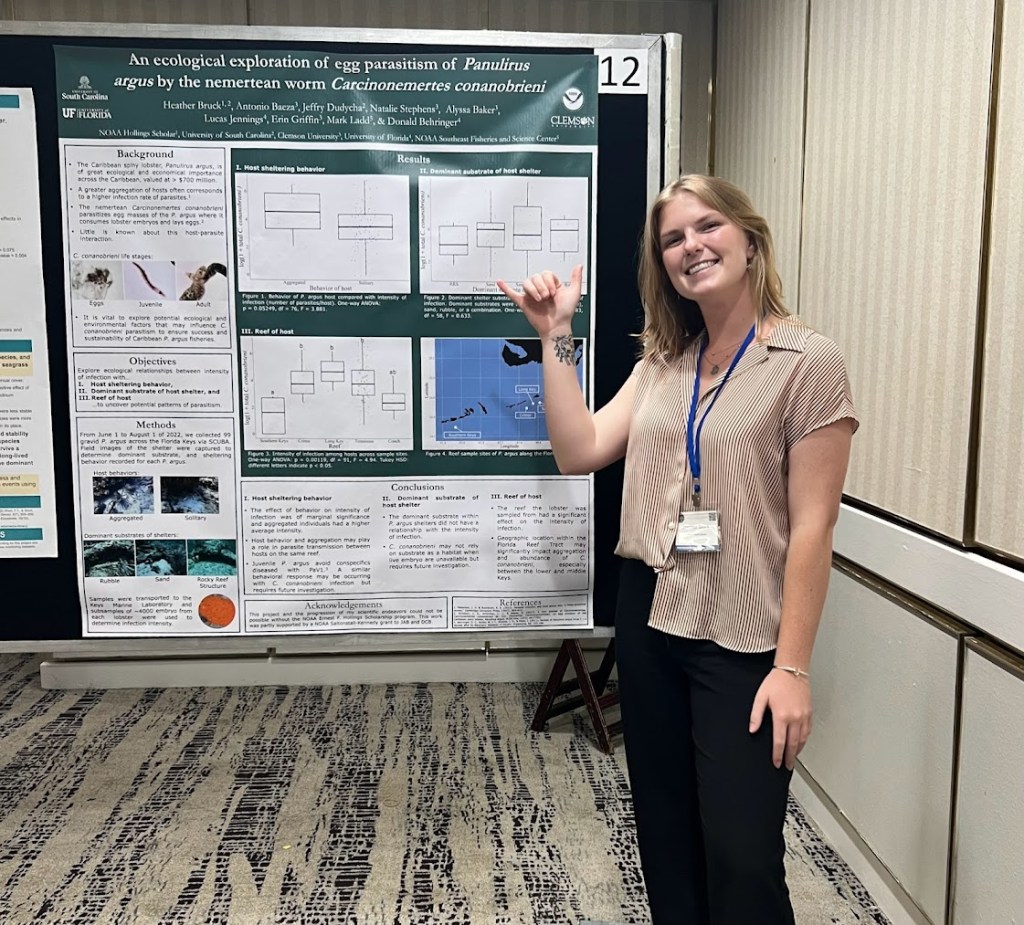
For my USC Honors Senior Thesis, I created an annotated R code of data analysis, GIS maps of C. conanobrieni intensity, and a manuscript of the information gathered during my N.O.A.A. Ernest F. Hollings internship and subsequent analyses. Through this experience I gained coding proficiency with R, using GIS to create heat maps of C. conanobrieni intensity, and forming a manuscript from a large dataset and variety of ecological information. My mentors during this process are Dr. Jeffry Dudycha and Dr. Jake Swanson. I defended my thesis and presented highlighted aspects of my work through poster presentations at USC’s Discovery Day and Benthic Ecology’s 2023 Annual Meeting.
Field and Laboratory Ecologist
Summer 2022
As part of my N.O.A.A. Earnest F. Hollings scholarship, I conducted an internship under the guidance of Dr. Mark Ladd (N.O.A.A. SEFSC) and Dr. Donald Behringer (UF) to develop hands-on, practical experience in research. The project, titled “Is there a relationship between habitat characteristics and intensity of Carcinonemertes conanobrieni on the Caribbean spiny lobster, Panulirus argus?”, combined landscape and parasite ecology in a collaborative manner. While assisting Master’s student Natalie Stephens in Dr. Antonio Baeza’s lab (Clemson) with her project investigating the impact of C. conanobrieni on P. argus fecundity and reproductive health, I collected field data regarding sampled lobster dens and surrounding habitat characteristics. This data was assessed with C. conanobrieni intensity among and across individuals to investigate the potential relationship between certain habitat characteristics (eg. dominate structural organism, substratum characteristics, aggregation of female P. argus, etc.) and intensity of C. conanobrieni infection.


Diving Research Assistant
Spring 2022
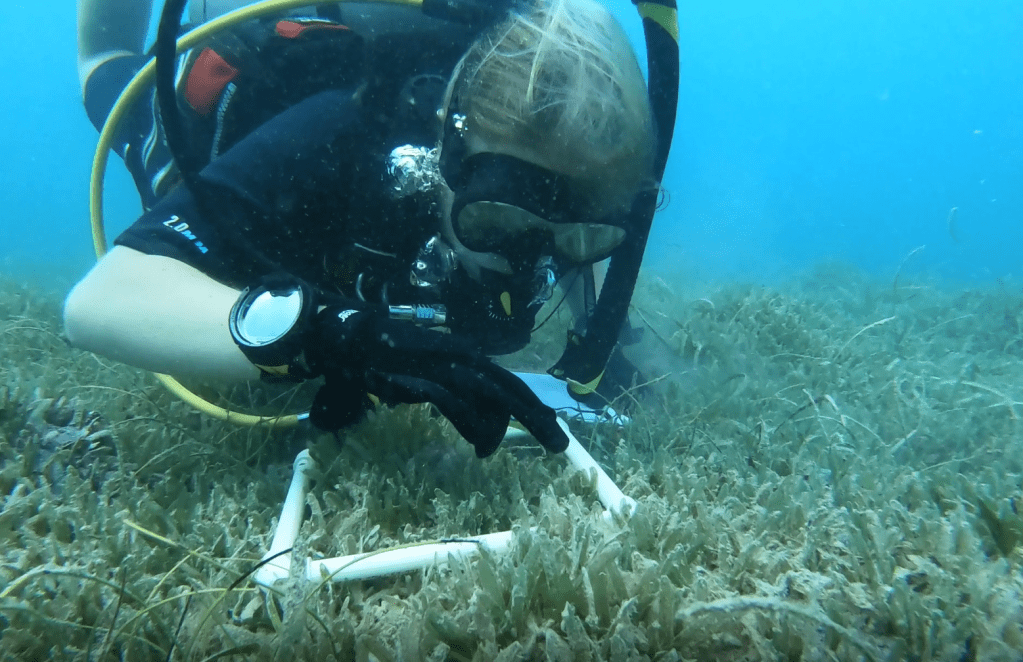
While studying away at the University of the Virgin Islands, I assisted graduate student Matt Souza with various projects. His work focuses on the range of invasive seagrass, Halophila stipulacea, and how it effects local invertebrate populations. My contributions include radial and line transect surveys, invertebrate collection and identification, and experimental design trials for conch predation studies as an AAUS scientific diver. My invertebrate identification skills improved tremendously while assisting Matt, and my understanding of community interactions among seagrass beds is continuing to expand.
Gas Chromatography Analyst
Fall 2021
This part-time employment in Dr. Nick Peng’s lab at USC involved analyzing gas chromatography samples of various marine fungi species. The overarching goal was to investigate the output of greenhouse gas (N2O-, CO2, CH4) emission in fungi samples. The data collected provided background information of the marine fungi species to be developed on in future studies. My contributions also contributed to a manuscript published by Frontiers in Marine Science; Lazo-Murphy, B., Larson, S., Staines, S., Bruck, H., McHenry, J., Bourbonnais, A., & Peng, X. (2023). Nitrous oxide production and isotopologue composition by fungi isolated from salt marsh sediments. Frontiers in Marine Science. Other skills learned included inoculation of cultures, inputting data into MATLAB, and GC machine maintenance.
Limnology Independent Project
Fall 2021
Designed, conducted, and analyzed results of absorption data of phytoplankton community samples. The samples were the same used in the Phytoplankton Community Experiment (see below). A UV-Spectrophotometer was used to measure absorption of phytoplankton communities in different light treatments and phosphorus levels. The goal was to assess competition among phytoplankton groups in the specified treatments over a 54 day time span using absorption data as well as species identification from PhD candidate Jake Swanson. David Abdulrahman, a senior undergraduate at UofSC, was also a big help throughout the project by contributing to the collection and maintenance of phytoplankton in microcosms. I found that overall community absorption can act as an indicator of community composition shifts towards cyanobacteria or cryptophyte dominance when acclimated to certain light and phosphorus conditions. This was my first experience creating my own graphs and analyzing my own data in R, as well as creating and presenting a poster. It was a valuable learning experience, and the mentorship provided by Dr. Dudycha, Dr. Richardson, Dr. Pinckney, and Jake Swanson was incredibly helpful. I presented this project as a poster at the Ecological Society of America conference in Montreal, Canada in August of 2022. Travel to ESA was funded by the Magellan Voyager Grant, UofSC Honors College Conference Travel Grant, and a contribution by the UofSC Biological Sciences Department.
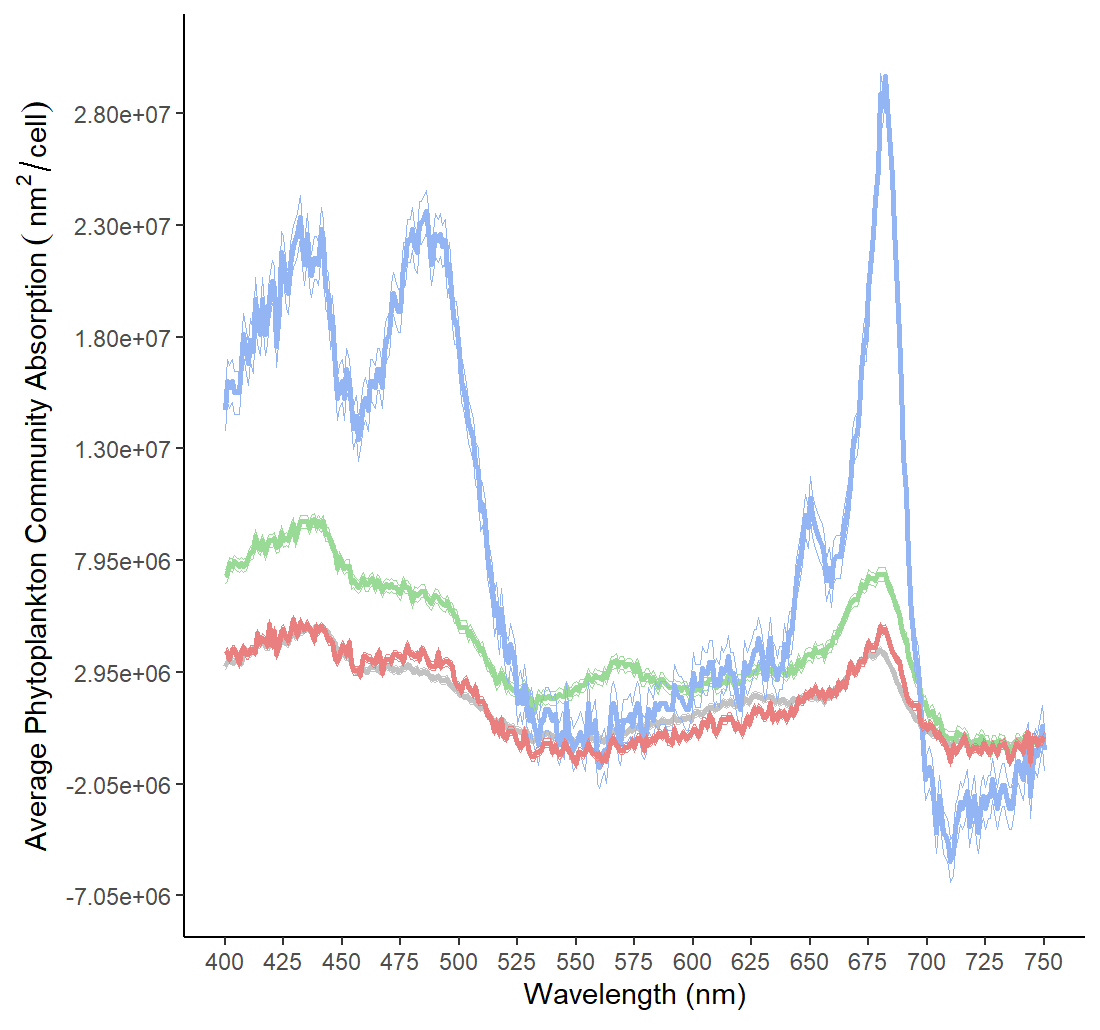

Figures of phytoplankton community absorption across light treatments and phosphorus conditions. The left figure displays community absorption in low phosphorus, and the right figure displays community absorption in high phosphorus.
Phytoplankton Community Experiment
Fall 2021
I assisted PhD candidate Jake Swanson with his project focused on phytoplankton community ecology. Water samples from local SC lakes were introduced to light (full, blue, red, green) and phosphorus (high or low) treatments. I assisted with the initial water collection, occasional sampling over the 54 day experiment, and preparing materials for the project.
Lab Technician
Fall 2020 – Summer 2021
As a part-time position during school and full-time during the summer, I worked as a lab technician in Dr. Jeffry Dudycha’s lab at U of SC. My general duties included maintenance of water flea populations, filtering lake water, cultivating algae, sterilizing equipment, and various lab maintenance responsibilities.
 Heather Bruck